4 days (3–4 hours of water training per day)
2–5 people
Beginner Friendly — progresses to Class II
Mid-September to end of June
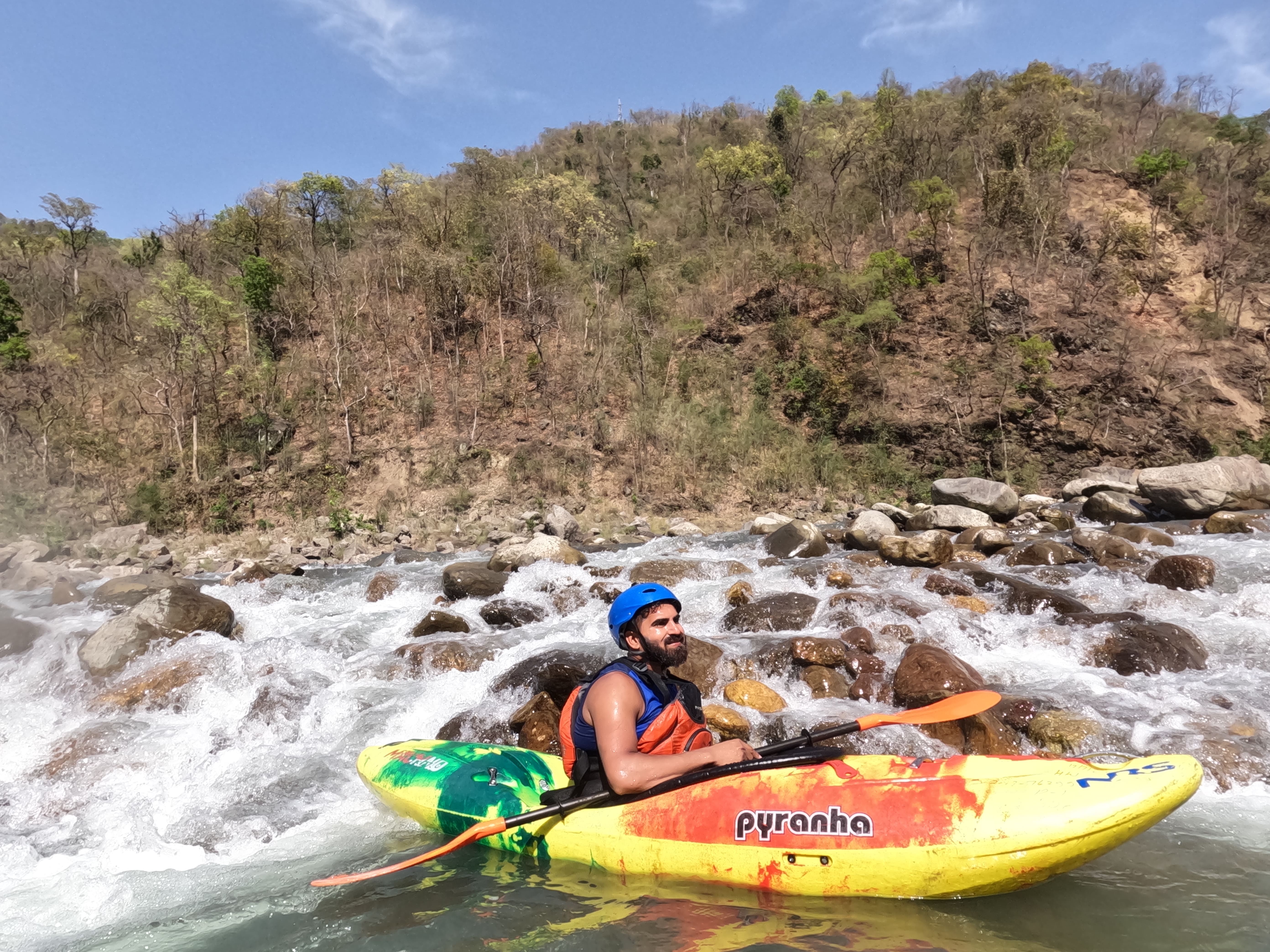
The 4-day Basic Kayak Course is designed around one principle: by the end of Day 4, you navigate Class II whitewater independently. Not "assisted by an instructor beside you" or "with a safety line attached" — independently, using skills you've built systematically over four mornings on the Ganga. It's a achievable goal that requires focused practice, and Sea Hawk Adventures' certified instructors have been delivering exactly this outcome for over three decades.
Day 1 starts on land. We've found that the clearest path to water confidence is understanding what the kayak is doing and why — so before you put the boat in the river you'll cover paddle mechanics, boat edging, and basic river hydrology. The afternoon flat-water session introduces wet exits: deliberately capsizing and swimming out of the kayak until it feels completely routine. This is the single most important thing a new kayaker can learn, because it removes the fear of capsizing entirely. Most participants do it 5–10 times on Day 1.
Day 2 moves onto moving water and introduces the two core river-kayaking skills: eddy turns and river crossings. Both require you to combine boat lean, paddle angle, and current reading simultaneously — they feel counterintuitive and then suddenly click. Day 2 also begins Eskimo roll training in calm water. The Eskimo roll is the technique that allows you to right a capsized kayak without swimming — it is the most satisfying and sought-after skill in the sport, and the calm-water environment on Day 2 is specifically chosen to give you the best possible chance of landing your first successful roll.
Day 3 brings you to your first proper Class II rapid — the moment the earlier training starts to pay off. Eddy turns and crossings are the tools you use to navigate the rapid; river reading is the skill that tells you which line to take. The afternoon is a short mini-expedition on moving water where the skills are applied continuously rather than in isolation.
Day 4 consolidates and finalises. Morning session focuses on Eskimo roll in moving water — the harder and more meaningful version of the skill. Afternoon is a final Class II run with progressively less instructor guidance, culminating in you navigating a rapid sequence on your own. A certificate of completion is presented at the end of the day.
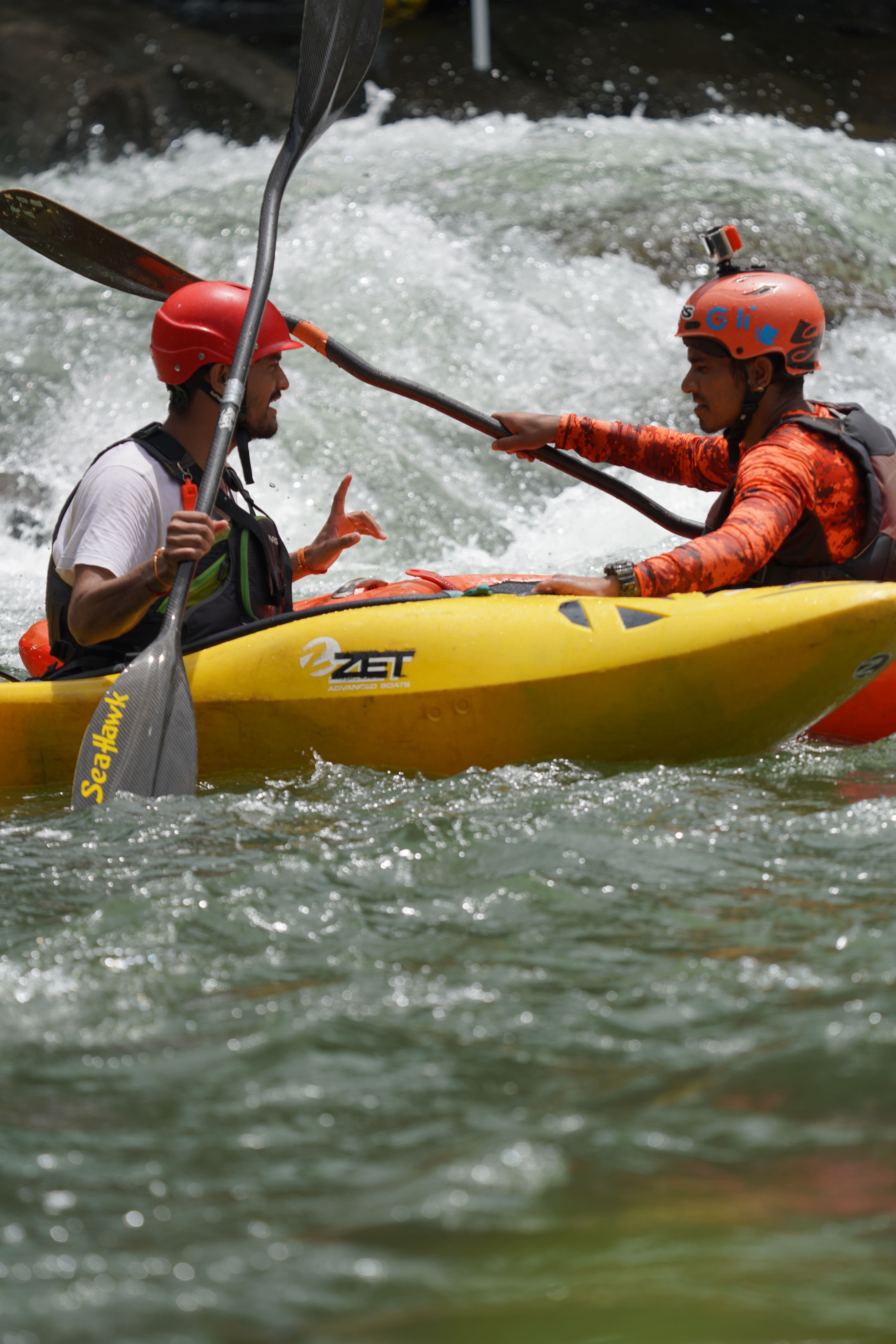
Sessions run 3–4 hours daily. Groups are capped at 5 people per instructor to ensure the instructor-to-student ratio is high enough for meaningful individual feedback. All equipment — including paddle, boat, spray deck, life jacket, and helmet — is provided and maintained to international standards. Wet suits and booties are provided free in winter.
The course opens with a dry-land session covering kayak anatomy, paddle grip and posture, forward stroke mechanics, sweep strokes, and how the boat responds to edge shifts. You'll also cover basic river hydrology — how to read current, identify eddies, and understand why water moves the way it does. In the afternoon you take to a calm flat-water section of the Ganga for your first paddle. The goal today is simple: get comfortable in the boat, learn to control direction, and practise a controlled wet exit (deliberately capsizing and swimming clear of the boat). Most participants do 5–10 wet exits on Day 1 — by the end it feels routine, which is exactly the point.
Day 2 moves onto moving water — a gentle Grade I–II section near the training site. You'll learn the two most fundamental river-kayaking skills: the eddy turn (paddling from main current into a calm pool behind a rock) and the river crossing (ferrying across the current without losing ground downstream). Both feel counterintuitive at first and click into place with practice. The second half of the session introduces the Eskimo roll — the self-rescue technique that lets you right a capsized kayak without swimming. Day 2 Eskimo roll work is done in calm water with instructor support; most participants get their first successful roll by the end of the day.
Today is the moment the previous two days of training clicks. Your group paddles a proper Class II rapid for the first time, with your instructor leading from the eddy below and the safety kayaker positioned above. The focus is on choosing a line, reading the water before entry, and using the eddy turns and crossings you've practised to navigate the rapid with control rather than luck. The afternoon is a short mini-expedition — a 3–4 km stretch of moving water where you apply all your skills continuously. End-of-day debrief with video review where available.
The final day focuses on consolidating everything and correcting any technique gaps identified in Day 3. Morning session concentrates on Eskimo roll in moving water — which is harder than in flat water and the true test of the skill. Afternoon is a final Class II run, longer than Day 3's, where you navigate the rapid sequence with increasing independence. Your instructor reduces prompting progressively so that by the finish line you're reading and running the water yourself. Certificate of completion presented at the end of the day.
Sessions run 9:00 AM–12:00 PM (winter) and 8:00 AM–11:00 AM (summer). Afternoon slots available on request subject to water conditions.
Quick-dry shorts or leggings and a rash guard or T-shirt. Flip-flops or old trainers. Wet suit is provided by the school in winter.
A water bottle and small snack. Sunscreen (water-resistant). Cash for tea and snacks at the training site. Your phone stays in the instructor's dry bag during sessions.
Basic swimming ability is required. You do not need to be a strong swimmer — the life jacket keeps you afloat at all times — but you should be comfortable in water.